
Reprogramming the Liver to Rejuvenate Immunity: MIT Team Reverses T-Cell Aging
With the accelerating global aging process, the "aging" of the immune system has become a critical challenge affecting healthy lifespan. Statistics show that people over 65 are more than three times more likely to be hospitalized due to infectious diseases than younger people, and cancer incidence also increases significantly with age. The decline in immune system function is considered one of the important contributing factors. Particularly worrying is the generally weaker response of older adults to vaccines, meaning that even vaccination provides significantly reduced protection.
Against this backdrop, how to "reboot" the aging immune system has become a cutting-edge research area in the medical field. Recently, a research report published in Nature, titled "Transient hepatic reconstitution of trophic factors enhances aged immunity", showed that scientists from MIT and other institutions successfully rebuilt a "temporary thymus factory" in aged mice by delivering specific mRNA to the liver, significantly increasing the number and function of T cells, and even enhancing anti-cancer immunotherapy efficacy. This study not only provides a new approach to anti-aging immune intervention but also demonstrates the immense potential of mRNA technology in systemic immune regulation.
Immune Aging: Thymus "Retirement", T Cell "Supply Shortage"
To understand the value of this study, it's necessary to first understand how the immune system ages. The "special forces" of the human immune army-T cells-primarily develop and mature in the thymus; the thymus acts like a "recruit training camp", not only screening T cells that can recognize different pathogens but also secreting various cytokines to help T cells survive and maintain their function. However, from early adulthood, the thymus begins to gradually atrophy, a process called "thymic involution". By around age 75, the thymus is largely dysfunctional, leading to a sharp decline in the production of new T cells and a decrease in T cell repertoire diversity. This is why older people are more susceptible to infections and cancer, and why vaccine effectiveness is reduced.
Previous attempts to rejuvenate the immune system have mostly focused on directly injecting recombinant cytokines or transplanting stem cells, but these methods are often accompanied by side effects such as inflammation and autoimmunity, limiting their clinical feasibility.
Turning the Liver into a "Temporary Thymus Factory"
In this study, the researchers took a different approach: instead of directly repairing the thymus, they created a "temporary factory" elsewhere in the body to mimic the thymus's secretion of key signaling molecules. They chose the liver as the "factory location" for three reasons: firstly, the liver maintains strong protein synthesis capabilities even in old age; secondly, the liver is more receptive to mRNA delivery; and thirdly, the systemic blood circulation passes through the liver, facilitating T cell "signal reception". Through multi-omics analysis of the immune microenvironment in young and old animals, the research team identified three key signaling pathways that significantly decline with age: Notch ligand DLL1, FLT3 ligand (FLT3L), and interleukin-7 (IL-7). These three factors work together on lymphoid progenitor cells to promote T cell development and survival.
The researchers packaged the mRNA encoding these three factors into lipid nanoparticles and injected them into aged mice. The nanoparticles accumulated in the liver, and liver cells took up the mRNA and began producing these proteins, essentially creating a "signal secretion station" within the liver.
The results showed that this "liver programming" strategy significantly improved the immune function of aged mice in the short term:
(1) T cell number and diversity recovered: After treatment, common lymphoid progenitor cells proliferated in the mice, increasing the production of new T cells, without affecting hematopoietic stem cell composition.
(2) Enhanced vaccine response: After vaccination with a model antigen (ovalbumin), the number of antigen-specific CD8+ T cells in aged mice receiving mRNA treatment doubled compared to the untreated group.
(3) Anti-cancer immunity "boost": When combined with immune checkpoint inhibitors (anti-PD-L1) for tumor treatment, mice receiving mRNA treatment showed significantly improved survival rates, increased T cell infiltration in tumors, and enhanced clonal diversity.
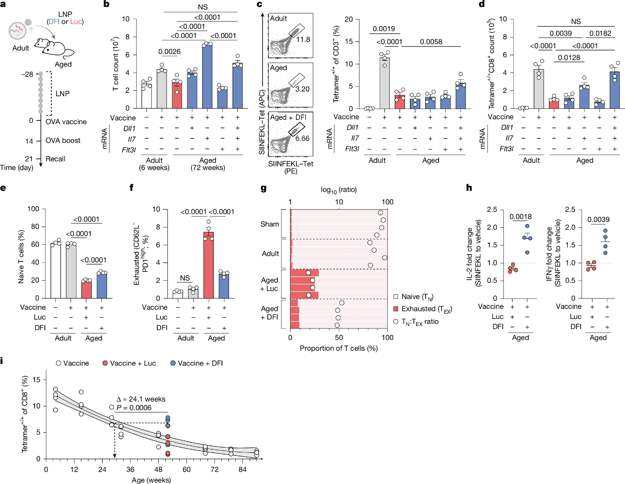
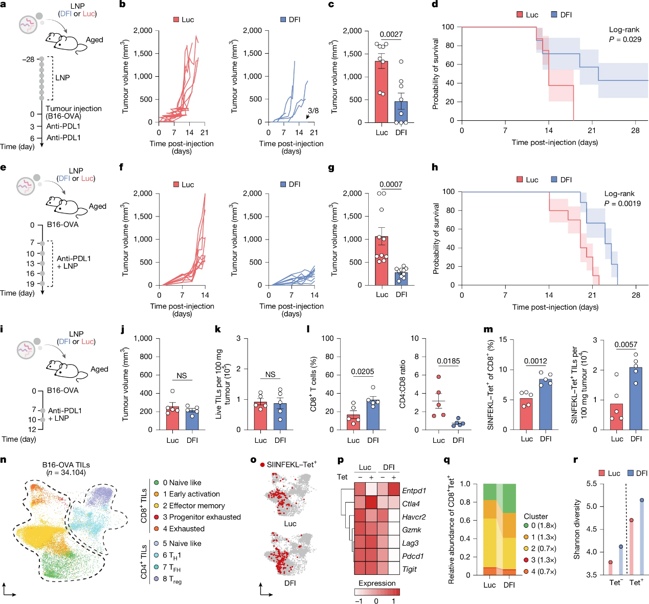
Importantly, this effect was reversible after cessation of treatment and did not disrupt self-immune tolerance, thus avoiding the inflammation and autoimmune risks common in traditional cytokine therapies. Researcher Feng Zhang stated that their method is more like a "synthetic thymus", using engineering techniques to allow the body to simulate thymus function. If they can restore such a core function of the immune system, they hope to help people maintain health for longer periods in old age.
Currently, this study is still in the animal experiment stage, but it has already pointed the way towards clinical translation. The researchers plan to further explore other animal models and search for more signaling factors that can enhance immunity.
Accelerate your programs by leveraging Creative Bioarray's extensive inventory and prospective network of cell products.
| Cat. No. | Product Name |
|---|---|
| CSC-C4645L | Aged Mouse Thymus Endothelial Cells |
| CSC-C4669L | Aged Mouse Thymus Epithelial Cells |
| CSC-C4693L | Aged Mouse Thymus Fibroblasts |
| CSC-C4711L | Cynomolgus Monkey Thymus Fibroblasts |
| CSC-C4734L | Cynomolgus Monkey Thymus Epithelial Cells |
| CSC-C4856L | Human Thymus Fibroblasts |
| CSC-C9392W | Human Thymic Epithelial Cells |
| CSC-C4869L | Human Thymus Microvascular Endothelial Cells |
| CSC-C5385S | Mouse Thymus Stromal Cells |
| CSC-C5034S | Rat Thymic Stromal Cells |
| CSC-7638W | Normal Human Peripheral Blood T-Lymphocytes(CD3+) |
| CSC-7639W | Normal Human Peripheral Blood T-Cells(CD4+) |
| CSC-7643W | Normal Human Peripheral Blood Naive T Killer Cells(CD8+) |
| CSC-7644W | Normal Human Peripheral Blood Naive T Helper Cells (CD4+) |
| CSC-7645W | Normal Human Peripheral Blood Activated T Killer Cells |
Reference:
- Friedrich, Mirco J., et al. "Transient hepatic reconstitution of trophic factors enhances aged immunity." Nature (2025): 1-9.
Your email address will not be published. Required fields are marked *