
ELISA Results You Can Trust — Critical Protocol Details That Make or Break Your Assay
In the world of cell-based research, ELISA (Enzyme-Linked Immunosorbent Assay) serves as a precision "signal catcher," enabling quantitative detection of target cytokines from complex cell culture supernatants. This comprehensive guide walks you through the critical operational details that separate reliable data from experimental artifacts.
Pre-Experiment Reminder: Always equilibrate the ELISA kit components to room temperature before use. Temperature discrepancies between reagents and assay conditions are a leading cause of inconsistent standard curves.
1. Understanding the ELISA Principle
ELISA is a widely adopted immunological technique for the detection and quantitative analysis of specific antigens or antibodies in biological samples. Characterized by high sensitivity and specificity, ELISA leverages antibody-antigen binding interactions to generate a measurable colorimetric signal proportional to analyte concentration.
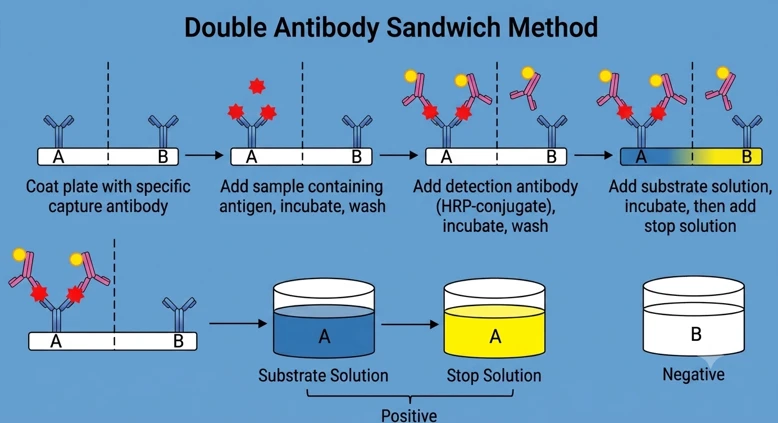
Four primary assay formats exist: direct ELISA, indirect ELISA, sandwich ELISA, and competitive ELISA. Among these, the sandwich ELISA (double-antibody sandwich method) is the most prevalent in commercial applications due to its superior specificity and broad dynamic range.
Sandwich ELISA Mechanism
In this format, a capture antibody is immobilized onto the microplate surface. The target antigen in the sample binds to this capture antibody, followed by detection with a second enzyme-conjugated antibody. Substrate addition produces a colorimetric reaction, the intensity of which correlates directly with antigen concentration.
2. Materials & Equipment
Consumables
- 96-well microplate
- Multichannel pipettes & tips
- Plate sealing film
Reagents
- Sample dilution buffer
- PBS wash buffer
- Blocking solution (5% skim milk or 3% BSA)
- Primary & secondary antibodies
- Substrate solution & stop solution
- Reference standard (known concentration)
Equipment
- Microplate reader
- Orbital shaker
- Automated plate washer
- Centrifuge
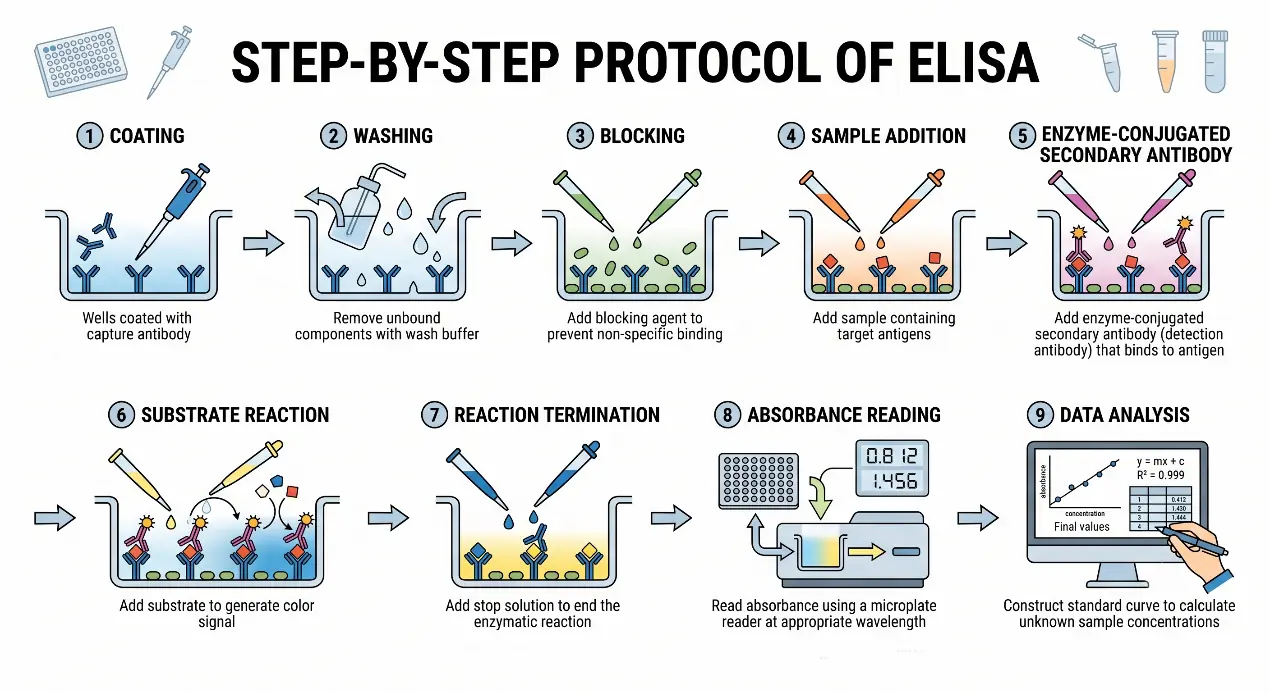
3. Step-by-Step Protocol
Coating
Add 100 µL of capture antibody (diluted in coating buffer), standards, or samples to each well of a 96-well plate. Seal the plate and incubate overnight at 4 °C to ensure stable antibody immobilization.
Washing
Discard well contents and wash the plate 3 times with 300 µL wash buffer per well. Gently tap the plate on absorbent paper between washes to remove residual liquid. Incomplete washing is a primary source of high background.
Blocking
Add 200 µL blocking solution per well and incubate at 37 °C for 1 hour to minimize non-specific binding. Repeat the washing step as described above.
Sample Addition
Add 100 µL of diluted samples or serially diluted standards to designated wells. Include blank control wells containing only dilution buffer. Incubate at 37 °C for 1 hour, then wash the plate thoroughly.
Enzyme-Conjugated Secondary Antibody
Add 100 µL of appropriately diluted enzyme-labeled secondary antibody to each well. Incubate at 37 °C for 1 hour. Perform washing steps as previously described.
Substrate Reaction
Add 100 µL of prepared substrate solution to each well. Incubate at room temperature protected from light for 15-30 minutes until a distinct color gradient becomes visible across the standard curve.
Reaction Termination
Add 100 µL stop solution to each well to halt the enzymatic reaction. Ensure uniform timing across all wells to prevent signal drift.
Absorbance Reading
Measure optical density (OD) at 450 nm using a microplate reader. Verify that the standard curve displays a monotonic increase in absorbance with increasing analyte concentration.
Data Analysis
Construct a standard curve by plotting mean absorbance (minus blank) against known standard concentrations. Use regression analysis (typically four-parameter logistic curve fitting) to interpolate unknown sample concentrations from the standard curve.
4. Results Analysis & Quality Control
Reliable ELISA data depends on rigorous quality control. Evaluate intra-assay precision by calculating the coefficient of variation (CV) across replicate wells—values below 10% are generally acceptable. The standard curve should exhibit an R² value ≥ 0.99 for reliable quantification.
When analyzing cell culture supernatants, account for matrix effects by diluting samples into the linear range of the assay. Always run samples in technical triplicate and include a full standard curve on every plate. Spiking recovery experiments and parallelism testing further validate assay accuracy for complex biological matrices.
Common pitfalls include edge effects (evaporation from peripheral wells), cross-contamination during pipetting, and substrate degradation from prolonged light exposure. Pre-wetting plates and using plate sealers mitigate many of these issues.
5. Conclusion
ELISA remains the gold standard for quantitative cytokine profiling in cell culture research. By adhering to precise coating, washing, and incubation protocols—and by implementing robust quality control measures—researchers can generate reproducible, publication-ready data. The difference between a failed assay and a trustworthy result often lies in the details: consistent technique, validated reagents, and meticulous attention to every washing step.
Need High-Quality ELISA Kits?
At Creative Bioarray, we provide rigorously validated ELISA kits, custom antibody development, and comprehensive cell biology services to accelerate your research. From cytokine profiling to specialized immunoassays, our technical team ensures reproducible results you can publish with confidence.
Your email address will not be published. Required fields are marked *