
A Step-by-Step Protocol of Transwell Cell Migration Assay
In cancer metastasis research, immune cell chemotaxis, and angiogenesis studies, the Transwell migration assay remains an indispensable classic technique. While the underlying principle is straightforward, seemingly minor operational details-if neglected-can produce data drift, or worse, complete cell loss. This guide provides a rigorous, step-by-step protocol to ensure reproducible, publication-quality results.
Principle of the Transwell Assay
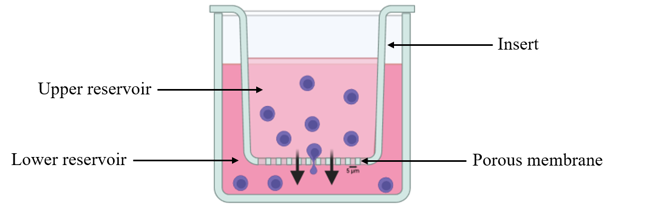
The Transwell insert is a specialized culture device used to study cell migration (chemotaxis), invasion (with Matrigel coating), and co-culture interactions. Its core structure consists of a cylindrical "insert" that fits into a standard multi-well plate, separated from the lower compartment by a porous polycarbonate membrane.
The upper chamber receives the cell suspension, while the lower chamber contains medium supplemented with chemoattractants (e.g., fetal bovine serum, growth factors, or conditioned medium). A concentration gradient drives cells to actively migrate through the membrane pores and accumulate on the underside-mimicking the directional movement required during physiological processes such as immune surveillance and tumor metastasis.
Key Design: Pore size selection is critical. Use 8.0 µm pores for most adherent cell lines (e.g., fibroblasts, epithelial cells); 3.0 µm or 5.0 µm for smaller cells (e.g., lymphocytes); and 0.4 µm for co-culture or barrier function studies where cell passage is not desired.
Step 1: Chamber Equilibration
1. Hydrate the Membrane
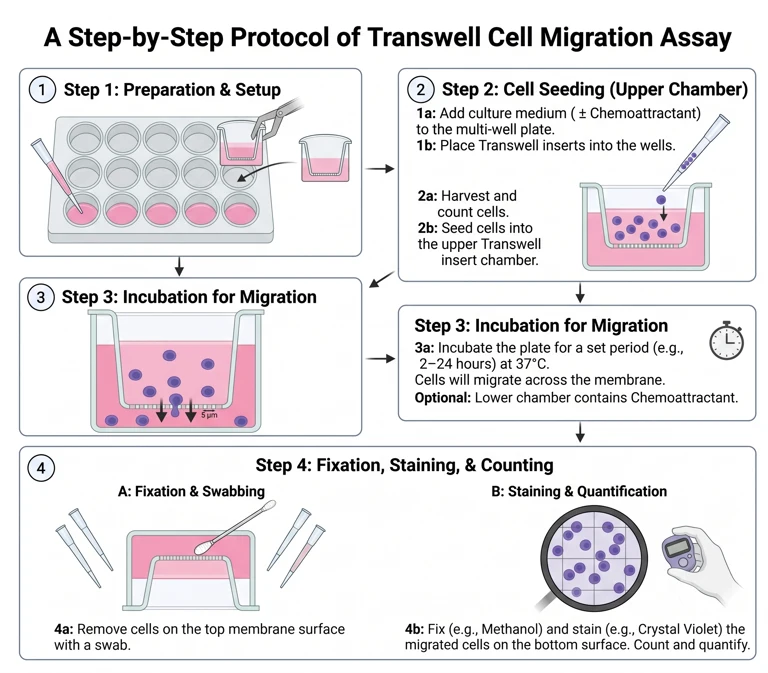
- Add serum-free medium to the wells of a 24-well plate.
- Place the Transwell insert into the well, ensuring the bottom membrane is fully submerged with no trapped air bubbles.
- Incubate at 37 °C for at least 1 hour to fully hydrate the polycarbonate membrane.
Note: Proper hydration enhances cell attachment uniformity and reduces edge effects, ensuring consistent migration across the membrane surface.
Step 2: Cell Suspension Preparation
2. Serum Starvation
- Select cells in the logarithmic growth phase with excellent morphology.
- Starve cells in serum-free medium for 12-24 hours prior to the experiment to synchronize the cell cycle and heighten sensitivity to chemoattractants.
3. Detachment & Washing
- Remove culture medium and wash cells with PBS (1-2×) to eliminate residual serum.
- Add 0.25% trypsin-EDTA to cover the monolayer; incubate at 37 °C for 1-3 minutes.
- Monitor under a microscope. Once cells round up, gaps widen, and initial detachment is visible, immediately neutralize with 2× volume of serum-containing medium.
- Gently pipette to achieve single-cell suspension.
4. Resuspension & Counting
- Centrifuge at 1,000 rpm for 5 minutes. Discard the supernatant.
- Resuspend in serum-free medium and wash by centrifugation (repeat 2×) to thoroughly remove serum traces.
- Resuspend in serum-free medium and adjust to a final density of 1-5 × 10⁵ cells/mL.
Note: Optimal seeding density must be determined empirically for each cell line based on cell size and intrinsic migratory capacity.
Note: Incomplete serum removal is a common source of high background. Residual serum in the upper chamber creates a chemoattractant gradient independent of the lower chamber, abolishing directional specificity.
Step 3: Seeding & Chemotaxis
5. Cell Seeding
- Retrieve equilibrated inserts from the 24-well plate.
- Carefully pipette 100 µL of the prepared cell suspension into the upper chamber.
- Deposit the suspension slowly and evenly to avoid bubble formation, which disrupts membrane contact and creates migration artifacts.
6. Lower Chamber Setup
- Add 600-750 µL of serum-containing medium (or medium with defined chemoattractant) to the lower well.
- Ensure the liquid level in the lower chamber is higher than that in the upper chamber to maintain hydrostatic pressure and prevent medium leakage into the insert.
7. Incubation
- Place the plate in a humidified CO2 incubator at 37 °C.
- Incubate for 12-24 hours. Duration should be optimized for each cell type-too short yields insufficient migration; too long leads to overcrowding and loss of single-cell resolution.
Step 4: Fixation, Staining & Counting
8. Washing & Fixation
- Remove inserts and gently wash the upper and lower surfaces with PBS (2× each).
- Add 4% paraformaldehyde (PFA) to completely cover the membrane. Fix at room temperature for 30 minutes.
9. Staining
- Discard PFA and wash inserts with PBS (3×).
- Add 0.1% crystal violet stain, ensuring the membrane is fully immersed. Stain at room temperature for 20 minutes.
- Discard stain and gently wash with PBS until the effluent is essentially colorless.
10. Microscopic Enumeration
- Place stained inserts under an inverted or upright microscope.
- Randomly select ≥5 high-power fields (HPF) per membrane.
- Count cells on the underside (basolateral surface) of the membrane only-cells remaining on the upper (apical) surface must be excluded or removed with a cotton swab prior to counting.
Data Analysis & Quantification
Microscopic Counting
Count migrated cells in ≥5 random HPFs per insert. Report as mean ± standard deviation (SD) or standard error of the mean (SEM). Normalize to a control condition (e.g., serum-free medium in both chambers) to calculate fold migration.
Colorimetric Quantification (Crystal Violet)
For higher throughput, destain the membrane with 33% acetic acid for 30 minutes. Transfer the eluate to a 96-well plate and measure absorbance at 570 nm on a microplate reader. OD570 values correlate linearly with cell number within the assay's dynamic range.
Statistical Analysis
Use an unpaired two-tailed Student's t-test for two-group comparisons. For three or more groups, apply one-way ANOVA followed by an appropriate post-hoc test (e.g., Tukey's or Dunnett's). Set significance at p < 0.05. Always report the statistical test and exact p-values in figure legends.
Pro Tip for Invasion Assays: To study invasion rather than mere migration, coat the upper membrane surface with a thin layer of Matrigel or collagen gel (typically 50-100 µg per well) before cell seeding. Cells must enzymatically degrade the ECM barrier to traverse the pores, providing a physiologically relevant model of extravasation and tissue infiltration.
Conclusion
The Transwell migration assay is deceptively simple in principle yet demands meticulous attention to detail in execution. From membrane hydration and serum starvation to precise seeding density and rigorous counting criteria, each step influences the final data quality. By following this standardized protocol and validating conditions for your specific cell model, you can generate robust, reproducible migration data that withstands peer review and advances your research in cancer biology, immunology, and beyond.
Need Transwell Inserts & Cell Culture Solutions?
At Creative Bioarray, we supply validated cell lines you need for reliable migration, invasion, and chemotaxis assays.
Validated Cancer Cell Lines — Authenticated, STR-profiled tumor cell lines with known migratory phenotypes - ideal for metastasis and drug screening studies.
Migration & Invasion Assay Kits — Complete kits including pre-coated Matrigel invasion chambers, crystal violet stain, and standardized protocols for reproducible results.
Custom Assay Services — Outsource your migration and invasion studies to our experienced team. We deliver raw data, statistical analysis, and publication-ready figures.
Your email address will not be published. Required fields are marked *