
3D Cell Culture & Organoids — Is Your Medium Keeping Up?
A postdoc in the lab was frustrated again: his lead compound performed beautifully in the culture dish, yet flopped completely in animal models. The culprit? Traditional 2D culture simply cannot replicate the complexity of living tissue. This guide breaks down the critical differences between 2D and 3D culture media, arming you with the formulation knowledge to close the translational gap.
The 2D Culture Problem
Conventional 2D cell culture forces cells to grow as flattened monolayers on rigid polystyrene surfaces. This artificial environment strips cells of their native three-dimensional architecture, abolishes physiologically relevant cell-cell and cell-matrix interactions, and fundamentally alters gene expression profiles and metabolic pathways.
The consequences are measurable and severe: drug responses observed in 2D assays diverge sharply from in vivo behavior, contributing to the staggering translational failure rate in pharmaceutical development.
Critical Statistic: Approximately 89% of drug candidates that show promise in preclinical studies ultimately fail in human clinical trials. A significant portion of this attrition is attributed to the predictive limitations of oversimplified 2D models.
How 3D & Organoid Cultures Bridge the Gap
3D culture technologies, and organoids in particular, recapitulate the three-dimensional tissue architecture, cellular heterogeneity, and cell-extracellular matrix (ECM) crosstalk that define native organs. By self-organizing into structures that mimic in vivo histology, organoids deliver a level of physiological fidelity that 2D monolayers cannot approach.
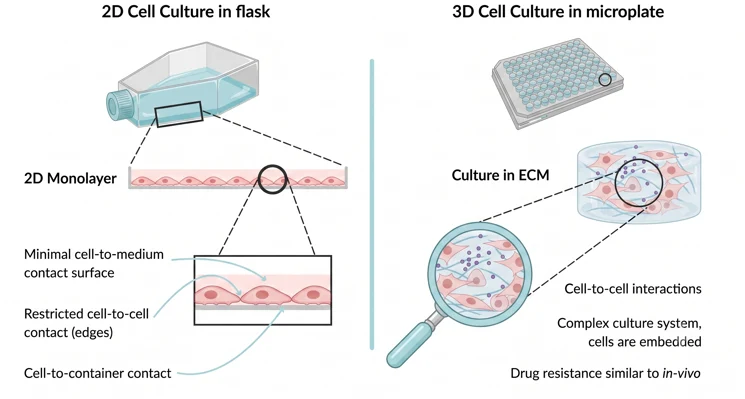
2D vs 3D Media: Core Differences
The shift from 2D to 3D is not merely a change in physical format—it demands a complete re-engineering of the culture medium. Below is a side-by-side comparison of the design philosophies:
| 2D Culture Medium | 3D / Organoid Medium | |
|---|---|---|
| Design Goal | Maximize rapid proliferation and expansion | Guide self-organization, differentiation, and tissue-specific patterning |
| Nutrient Concentration | Standard concentrations (e.g., 1× glucose, 1× glutamine) | Elevated concentrations (typically 1.5-2×) to compensate for diffusion gradients |
| Growth Factors | Basic cocktails (e.g., FGF, EGF) for general proliferation | Precisely timed, multi-factor combinations for lineage specification |
| Key Additives | Serum (provides undefined, variable factors) | Defined small-molecule pathway inhibitors and activators |
| Physical Support | Plastic surface of culture flasks or dishes | Matrigel, synthetic hydrogels, or other ECM-mimetic scaffolds |
The Four Pillars of 3D / Organoid Media
Nutrient Diffusion & Metabolic Support
Inside a 3D spheroid or organoid, nutrient and oxygen gradients form rapidly. Core regions often become hypoxic and acidic, driving oxidative stress and necrosis.
- Elevate basal nutrients: Increase glucose and glutamine concentrations to 1.5-2× standard 2D levels.
- Add antioxidants: Supplement with vitamin C and N-acetylcysteine (NAC) to combat hypoxia-induced reactive oxygen species (ROS).
Precision Signal Pathway Control
This is the most complex and critical dimension of organoid media. Successful self-organization requires precise recapitulation of developmental signaling cascades.
- Wnt pathway activation: CHIR99021 (GSK-3β inhibitor) — essential for endoderm-derived organoids (intestinal, hepatic, gastric) to maintain stemness and proliferation.
- TGF-β / BMP inhibition: A83-01 and LDN-193189 — suppress unwanted differentiation and promote epithelial expansion.
- p38 MAPK inhibition: SB202190 — reduces stress-induced apoptosis and improves viability.
- Rho kinase (ROCK) inhibition: Y-27632 — nearly universal in organoid protocols; dramatically suppresses anoikis after single-cell dissociation.
Tissue-Specific Growth Factors
Beyond standard 2D factors (EGF, FGF), 3D organoid systems require specialized morphogens:
- Noggin: A BMP antagonist critical for neural ectoderm- and endoderm-derived organoids (brain, intestine).
- R-spondin 1: Potentiates Wnt signaling; indispensable for epithelial organoids (intestinal, hepatic, gastric).
- Organ-specific factors: Hepatocyte Growth Factor (HGF) for liver organoids; FGF10 and FGF7 for lung organoids.
Matrix-Medium Synergy
The culture medium must be co-engineered with the 3D scaffold. Matrigel and synthetic hydrogels are not passive supports—they are active signaling platforms.
- Matrigel composition: Provides basement membrane proteins (laminin, collagen IV, entactin) that engage integrin receptors and trigger mechanotransduction.
- Medium permeability: Formulation components must efficiently diffuse through the hydrogel matrix to reach every cell layer.
- Mechanosensing: Medium supplements should support integrin-mediated sensing of matrix stiffness, which directly modulates proliferation, differentiation, and polarity.
Example Formulation: Intestinal Organoid Medium
The following represents a validated, publication-ready formulation for murine or human intestinal organoid culture:
| Component | Category | Role |
|---|---|---|
| Advanced DMEM/F12 | Basal medium | Nutrient foundation |
| R-spondin 1 | Growth factor | Amplifies Wnt signaling |
| Noggin | Growth factor | Inhibits BMP |
| EGF | Growth factor | Promotes proliferation |
| Y-27632 | Small molecule | Inhibits apoptosis |
| CHIR99021 | Small molecule | Wnt agonist (used at specific stages) |
| A83-01 | Small molecule | Inhibits TGF-β |
| B27, N2 | Supplements | Provide vitamins, lipids, hormones |
| N-acetylcysteine (NAC) | Antioxidant | Reduces oxidative stress |
| High-concentration glutamine | Nutrient | Fuels metabolism |
Conclusion
The transition from 2D to 3D cell culture is not a trend—it is a necessary evolution for translational research. By engineering media that account for nutrient diffusion gradients, precise developmental signaling, tissue-specific growth factors, and matrix-mediated mechanotransduction, researchers can build organoid models that genuinely predict in vivo biology.
Ready to Build Better 3D Models?
At Creative Bioarray, we provide the specialized reagents and expertise to make your 3D and organoid cultures reproducible, scalable, and publication-ready.
Organoid-Validated Media — Pre-formulated, lot-tested media for intestinal, hepatic, neural, and lung organoids — ready to use out of the box.
3D Culture Matrices — GMP-grade Matrigel alternatives, synthetic hydrogels, and ECM-mimetic scaffolds with defined mechanical properties.
Defined Small Molecules — High-purity CHIR99021, Y-27632, A83-01, LDN-193189, and organoid-grade growth factors (R-spondin 1, Noggin, HGF).
Custom Formulation Services — Work with our applications scientists to design bespoke media tailored to your novel organoid model or co-culture system.
Your email address will not be published. Required fields are marked *