
HLA-Typed Cells: What Immunologists Can't Afford to Ignore
If your immuno-oncology assay yields irreproducible donor-to-donor variability, or your CAR-T cell therapy fails to show expected in vitro killing, the culprit may not be your protocol—it may be your cells' immunogenetic background. Human leukocyte antigen (HLA) genotype is the single most polymorphic genetic system in the human genome, and it governs virtually every interaction between antigen-presenting cells and T cells. Yet many labs still treat HLA background as an afterthought.
This guide explains why HLA-typed cells are indispensable for modern immunology, cell therapy, and drug development, and how to select the right typing resolution and allele panel for your research question.
What Are HLA-Typed Cells—and Why Does Genotype Matter?
The human leukocyte antigen (HLA) complex, encoded on chromosome 6, is the human equivalent of the major histocompatibility complex (MHC). It contains the genes responsible for immune self/non-self recognition.
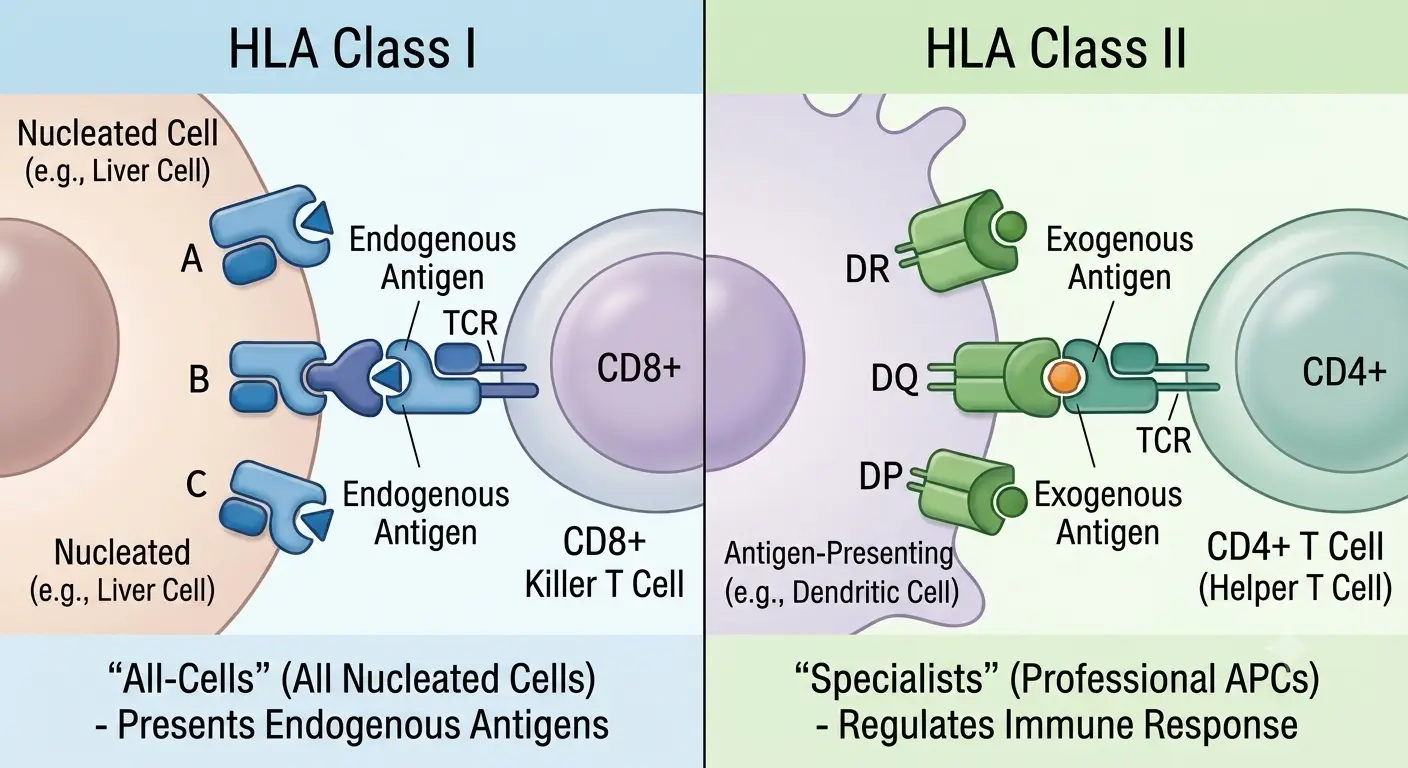
HLA molecules fall into two classes:
- Class I (HLA-A, HLA-B, HLA-C): Expressed on all nucleated cells; present endogenous peptides to CD8+ cytotoxic T cells.
- Class II (HLA-DR, HLA-DQ, HLA-DP): Expressed on antigen-presenting cells (APCs); present exogenous antigens to CD4+ helper T cells.
What makes HLA extraordinary is its polymorphism. HLA-B alone has more than 3,000 allele subtypes, and as of early 2021, over 30,000 HLA alleles had been assigned across all loci. For context, the gene determining ABO blood type has only three alleles. This extreme diversity means that two "healthy donor" PBMC samples can behave completely differently in the same T cell activation assay simply because they present peptides through different HLA restriction elements.
HLA-typed cells are primary cells or cell lines for which the HLA genotype has been determined at defined loci and resolution. Using them transforms immunogenetic background from a hidden confounder into a structured, traceable experimental variable.
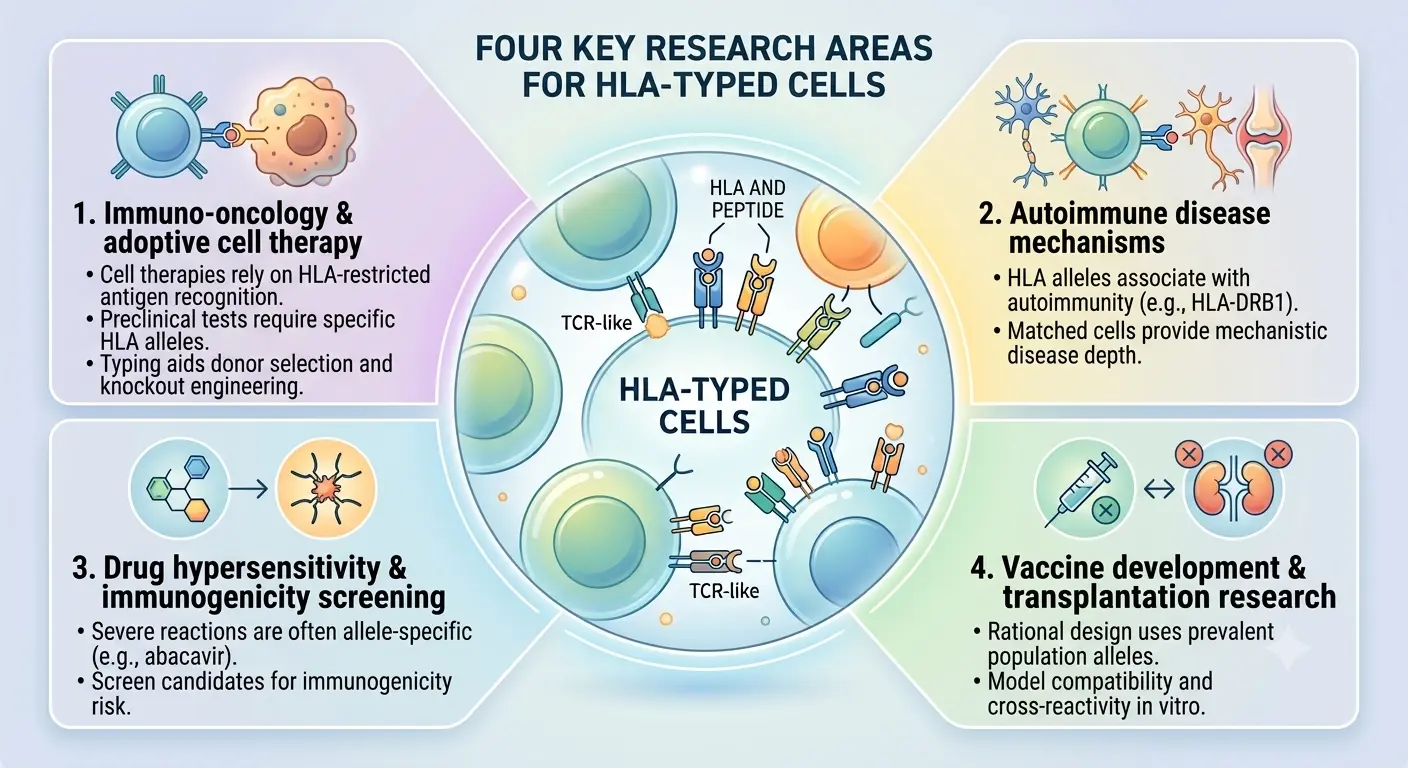
Four Research Areas Where HLA-Typed Cells Are Non-Negotiable
1. Immuno-Oncology & Adoptive Cell Therapy
T cell receptor (TCR) and chimeric antigen receptor T cell (CAR-T) therapies depend on HLA-restricted antigen recognition. A TCR does not recognize a tumor peptide in isolation—it recognizes the peptide–HLA complex.
Preclinical researchers developing TCR-T or TCR-like CAR-T constructs therefore require target cells expressing the specific HLA allele against which the therapy is restricted. HLA-A*02:01 remains the most frequently targeted allele because of its high prevalence in many populations, but therapies restricted to HLA-A*01:01, HLA-A*11:01, and other alleles are increasingly entering clinical trials.
In allogeneic CAR-T development, accurate HLA typing is equally critical for donor selection and for engineering "universal" hypoimmunogenic cell products via HLA knockout or silencing strategies.
2. Autoimmune Disease Mechanisms
Specific HLA alleles are strongly associated with autoimmune susceptibility. HLA-DRB1*15:01 correlates with multiple sclerosis; HLA-DRB1*04:01 with rheumatoid arthritis; and the DR3-DQ2 haplotype with type 1 diabetes.
When studying disease mechanisms or testing therapies in vitro, using HLA-matched primary T cells or APCs as healthy controls—or comparing high-risk versus protective haplotypes—adds mechanistic depth that untyped donor cells cannot provide.
3. Drug Hypersensitivity & Immunogenicity Screening
Adverse drug reactions mediated by the adaptive immune system are often HLA-restricted. The landmark example is abacavir, an antiretroviral drug: approximately 8 % of patients carrying HLA-B*57:01 develop hypersensitivity reactions. The evidence was so compelling that the FDA issued a black-box warning recommending pre-therapy HLA screening.
In preclinical development, HLA-typed APCs and T cells allow researchers to screen biologics and small molecules for allele-specific immunogenicity risk before candidates reach the clinic.
4. Vaccine Development & Transplantation Research
HLA-typed cells enable rational vaccine design by identifying which HLA alleles in a target population are most likely to present conserved pathogen epitopes. In transplantation research, HLA-typed donor cells support compatibility studies, cross-reactivity testing, and graft-versus-host disease (GvHD) modeling under controlled in vitro conditions.
HLA Typing Resolution: A Practical Guide
Not every experiment requires maximum resolution. HLA typing is reported in fields (digits), with each level adding specificity:
| Resolution | Method | Practical Use Case |
|---|---|---|
| Low (1-field) | Serology, SSO | Basic sample annotation; population screening |
| High (2-field) | SSP, SBT, NGS | Most preclinical research; distinguishes protein-level differences |
| Allele-level (3–4-field) | NGS, single-molecule sequencing | HLA-editing studies; allele-specific TCR recognition; clinical-grade matching |
For most immuno-oncology and drug-development workflows, 2-field (high-resolution) typing is sufficient because it distinguishes the protein-relevant differences that drive T cell recognition.
If your program involves CRISPR-mediated HLA knockout, iPSC haplobanking, or allele-specific peptide-binding assays, 4-field allele-level resolution may be necessary to resolve closely related subtypes and phase ambiguity.
Which Loci Should You Type?
- Class I (HLA-A, HLA-B, HLA-C): Essential for CD8+ T cell and NK cell studies, most TCR-T/CAR-T platforms, and tumor antigen presentation assays.
- Class II (HLA-DRB1, HLA-DQB1, HLA-DPB1): Critical for CD4+ T cell responses, APC biology, autoimmunity research, and helper-T-dependent vaccine efficacy.
A standard research panel covering HLA-A, -B, -C, -DRB1, -DQB1, and -DPB1 provides comprehensive metadata for the majority of immunology workflows.
Choosing Between Primary Cells and Engineered HLA Cell Lines
Primary HLA-typed cells (e.g., PBMCs, isolated T cells, or dendritic cells) preserve endogenous expression levels, co-receptor ratios, and physiological signaling thresholds. They are the gold standard for studying polyclonal immune responses, but they introduce donor-to-donor biological variability that must be controlled through careful HLA matching.
Engineered HLA-expressing cell lines (e.g., K562 or PC9 lines stably transduced with a single HLA allele) eliminate donor variability and provide a clean, isogenic background for antigen-presentation studies. They are ideal when you need to test a TCR or antibody against one specific peptide–HLA restriction element without confounding alloreactivity.
The best strategy depends on your research question: use primary cells to model patient-like diversity and physiological responses; use engineered lines to isolate the contribution of a single HLA allele.
Source HLA-Typed Cells and Typing Services from Creative Bioarray
From high-resolution HLA genotyping to ready-to-use engineered cell lines, Creative Bioarray provides integrated solutions that turn immunogenetic background from an experimental liability into a controlled variable:
HLA Typing Services
- Human Leukocyte Antigen Typing Services — offering both medium-resolution (SSP/SSO, up to 3-digit) and high-resolution (NGS, up to 4-digit) typing for gDNA and cell line samples.
Coverage includes HLA-A, -B, -C, -DRB1, -DRB3/4/5, -DQA1, -DQB1, -DPA1, and -DPB1, with flexible single-target or multi-target panels tailored for cell therapy development, cancer vaccine design, and disease susceptibility research.
HLA-Expressing Stable Cell Lines
- K562-HLA-A*01:01 Stable Cell Line — a validated K562 clone expressing exogenous HLA-A*01:01 for antigen-presentation and TCR recognition assays.
- PC9-HLA-A*02:01 Stable Cell Line — lung adenocarcinoma–derived cells engineered to present peptides via the most common therapeutic target allele, HLA-A*02:01.
- PC9-HLA-A*11:01 Stable Cell Line — expanding your HLA coverage for population-diverse TCR-T and vaccine development programs.
All stable lines are validated for ≥10 passages, mycoplasma-negative, and shipped on dry ice for immediate integration into your drug-screening or biological assay workflows.
Primary Immune Cells
Creative Bioarray also supplies a broad inventory of human primary cells, including PBMCs and isolated immune subsets, that can be custom HLA-typed to your specifications—eliminating the need for cumbersome in-house genotyping and ensuring your donor cohort matches your target patient population.
Ready to close the genotype gap in your immunology workflow? Contact Creative Bioarray to discuss custom HLA typing panels, engineered cell line construction, or matched primary cell sourcing—and build experiments where immunogenetic background is a known variable, not a hidden confounder.
Your email address will not be published. Required fields are marked *