
Cultivated Meat Production: Why Cell Lines Are the Engine of the Industry
Cultivated meat—also called cell-based or cultured meat—is produced by isolating animal cells, expanding them in controlled culture conditions, and differentiating them into muscle, fat, and connective tissue. While bioreactors, scaffolds, and growth media often steal the spotlight, the true foundation of every cultivated meat process is the cell line.
What Are Cell Lines for Cultivated Meat Production?
A cell line is a population of cells that has been stabilized in culture, maintained through multiple passages, and proven to retain key characteristics such as proliferation capacity and differentiation potential. In the context of cultivated meat, a cell line should be capable of producing the two major edible cell types: skeletal muscle and adipose tissue (fat).
For food production, an ideal cell line must be:
- Proliferative: able to grow rapidly and at high density.
- Differentiable: able to become muscle fibers or fat cells.
- Genetically stable: maintain its characteristics over many passages.
- Serum-free adaptable: grow in animal-component-free media.
- Safe for consumption: no tumorigenic potential or harmful genetic changes.
Why the Cell Line Matters in Cultivated Meat?
Cell lines are not just a research tool—they are the manufacturing engine of cultivated meat. Here's why they matter so much:
1. Scalability
A single cultivated meat production run requires trillions of cells. Primary cells with a finite lifespan simply cannot provide that scale. Only long-lived, stable cell lines can support industrial-scale expansion in bioreactors.
2. Consistency
Cell lines provide biological reproducibility. A well-characterized cell line ensures that every batch of cultivated meat has the same texture, taste, and nutritional profile.
3. Cost Reduction
Robust cell lines require less expensive media, grow faster, and are more efficient in large-scale culture. This directly impacts the final cost of cultivated meat.
4. Regulatory Approval
Food safety agencies require traceable, thoroughly characterized cell lines. Master cell banks and working cell banks are essential for demonstrating safety and consistency.
Types of Cell Lines Used in Cultivated Meat Production
Several cell types can be used or engineered for cultivated meat. The most relevant are listed below.
| Cell Type | Source | Role in Cultivated Meat |
|---|---|---|
| Myosatellite cells | Skeletal muscle tissue | Muscle stem cells that proliferate and differentiate into myotubes/myofibers—the main contractile tissue in meat. |
| Preadipocytes / adipose-derived stem cells | Adipose tissue | Differentiate into adipocytes; contribute to marbling, flavor, and mouthfeel. |
| Immortalized myogenic cells | Primary muscle cells genetically or chemically modified | Provide long-term proliferation while retaining the ability to form muscle tissue. Often used for production-scale platforms. |
| Induced pluripotent stem cells (iPSCs) | Reprogrammed somatic cells | Can self-renew indefinitely and be directed toward muscle or fat lineages. Promising but differentiation protocols are complex. |
| Mesenchymal stromal cells | Fat, bone marrow, and other tissues | Useful for adipogenic (fat) differentiation in some systems, though not the primary choice for muscle generation. |
How Are Cell Lines Developed for Cultivated Meat?
Developing a production-quality cell line is a multi-step process requiring both cell biology and bioprocessing expertise.
1. Donor Tissue Acquisition
A small biopsy is taken from a healthy animal—such as a chicken, cow, pig, or fish. Donor selection can influence growth rate, fat deposition, and muscle characteristics.
2. Primary Cell Isolation
The tissue is digested with enzymes, and specific cell populations, such as satellite cells or preadipocytes, are isolated and cultured.
3. Establishment and Expansion
Primary cells are expanded in culture. However, most primary cells undergo replicative senescence after a limited number of divisions.
4. Immortalization or Stabilization
To overcome senescence, cells may be immortalized using strategies such as: a) Introduction of telomerase reverse transcriptase (TERT) to maintain telomere length. b) Modulation of cell cycle regulators such as p53, Rb, CDK4, or cyclin D1. c) Spontaneous immortalization after extended culture—though this is rare in most livestock species.
Immortalization must be carefully designed to avoid cancer-like transformation, especially since the final product is intended for human food.
5. Clonal Selection
Single-cell-derived clones are selected to generate a homogeneous population with consistent growth and differentiation behavior.
6. Characterization
Critical characterization includes: a) Cell identity and species verification, b) Karyotype and genomic stability, c) Growth kinetics and differentiation capacity, d) Mycoplasma, bacterial, and viral contamination testing.
7. Cell Banking
A master cell bank and working cell banks are cryopreserved to ensure traceability and reproducibility across batches.
8. Adaptation to Production Conditions
Finally, cells are adapted to serum-free, animal-free media and to suspension culture or microcarrier-based growth in bioreactors.
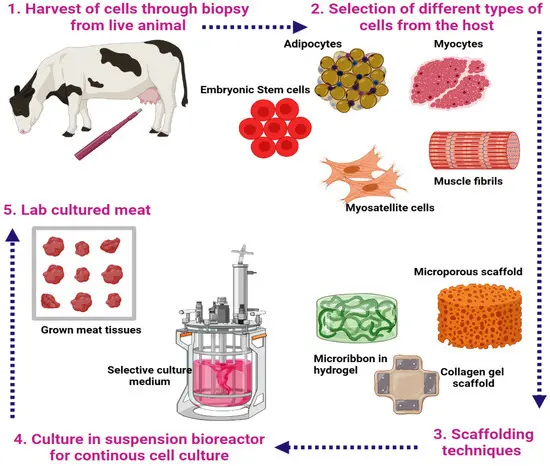
Key Challenges and Solutions in Cell Line Development
Despite progress in cultivated meat research, several challenges remain in creating optimal cell lines.
1. Replicative Senescence
Challenge: Primary cells stop dividing after a finite number of population doublings.
Solution: Immortalization through TERT expression or other cell-cycle engineering can extend proliferative life.
2. Tumorigenic Risk
Challenge: Some immortalized cells may acquire cancer-like properties.
Solution: Careful engineering, rigorous testing, and safety assays are needed to demonstrate non-tumorigenicity.
3. Serum-Free Adaptation
Challenge: Many cells grow well in fetal bovine serum (FBS), but FBS is expensive, inconsistent, and animal-derived.
Solution: Gradual adaptation to chemically defined, animal-free media using recombinant growth factors and optimized nutrient mixtures.
4. Cost of Growth Factors
Challenge: Recombinant proteins such as FGF2 and IGF-1 are expensive at production scale.
Solution: Cell line engineering to reduce growth factor dependence or increase growth factor efficiency is an active area of research.
5. Scale-Up in Bioreactors
Challenge: Cells must withstand shear stress, adapt to high-density culture, and remain viable in large volumes.
Solution: Cell line screening for suspension tolerance and integration with microcarriers or edible scaffolds.
6. Genetic Stability Over Time
Challenge: Extended passaging can lead to genetic drift and loss of differentiation capacity.
Solution: Low-passage banking, routine quality control, and monitoring of key markers.
Regulatory and Safety Considerations
Cultivated meat must meet strict food safety standards. Regulatory agencies evaluate not only the final product but also the production cell line. Key considerations include:
- Origin and traceability of the cell line
- Absence of tumorigenic potential
- Genetic stability at production scale
- Contamination control—microbial, mycoplasma, viral
- Compatibility of media components and scaffolds with food safety requirements
In the United States, the FDA and USDA share oversight of cultivated meat products. Singapore Food Agency has already approved a cultivated chicken product. In the European Union, cultivated meat would be regulated as a novel food. Strong cell line development is essential for meeting these evolving regulatory frameworks.
Support Your Cultivated Meat Research with Creative Bioarray
Developing a robust cell line is one of the most important steps in cultivated meat production. From primary cell isolation and immortalization to cell banking and serum-free adaptation, researchers need reliable tools, high-quality cells, and specialized expertise.
Creative Bioarray offers a broad portfolio of cell culture products and services to support cultivated meat and alternative protein research, including:
- Primary cells and cell systems
- Stable and immortalized cell lines
- Custom cell line development and immortalization services
- Cell characterization and quality control services
- Cell culture media and reagents
Whether you are conducting early-stage research or scaling up to production, Creative Bioarray can help you build the cellular foundation for sustainable meat.
Explore the full range of cell biology products and services at: https://www.creative-bioarray.com/
References
- Balasubramanian, B.; Liu, W.; Pushparaj, K.; Park, S. "The Epic of In Vitro Meat Production—A Fiction into Reality." Foods (2021).
- Reiss, J.; Robertson, S.; Suzuki, M. "Cell Sources for Cultivated Meat: Applications and Considerations throughout the Production Workflow." Int. J. Mol. Sci. (2021).
- Feddern, V. et al. "Cell Lines for Cultivated Meat Production." Springer, Cham (2024).
Your email address will not be published. Required fields are marked *