
What is FFPE Tissue and Why Does It Matter?
In biomedical research and clinical diagnostics, formalin-fixed paraffin-embedded (FFPE) tissue blocks have become a universal standard. By preserving tissue architecture and biomolecules in a stable form, FFPE allows researchers and clinicians to examine samples years, or even decades, after collection. Whether for cancer diagnostics, biomarker discovery, or educational use, theFFPE tissue sample remains one of the most valuable resources in modern pathology.
What are FFPE Tissue Blocks and How are They Prepared?
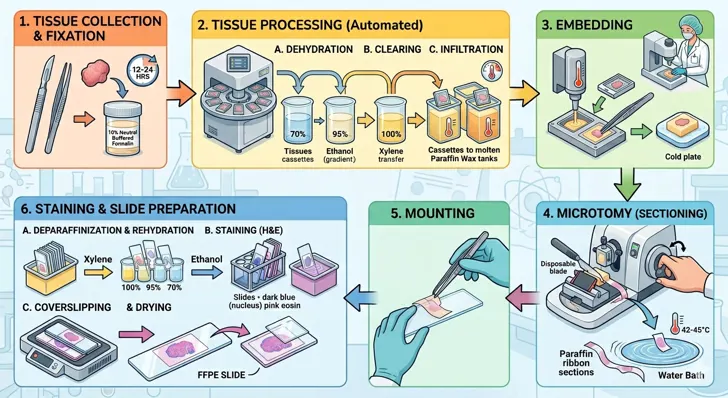
FFPE tissue blocks are created by fixing biological samples in formalin, which preserves cellular structures and proteins, followed by embedding them in paraffin wax. The result is a solid block that can be stored at room temperature and sectioned into thin slices for analysis.
1. Tissue Collection and Fixation
Fresh tissue (biopsy or surgical excision) must be immersed in 10% neutral-buffered formalin (NBF) within 30-60 minutes of removal to minimise ischemic degradation. Fixation time should range from 6 to 72 hours depending on tissue thickness.
Under-fixation (<6 hours) compromises morphology and causes false-negative immunohistochemistry results. Over-fixation (>72 hours) introduces excessive crosslinking that impairs nucleic acid recovery and introduces sequencing artifacts.
2. Dehydration and Clearing
The fixed tissue is dehydrated through a graded ethanol series (70% → 100%) to remove water, since paraffin cannot penetrate aqueous tissue. A clearing agent-traditionally xylene, though safer alternatives like d-limonene exist-then displaces the ethanol, making the tissue ready for paraffin infiltration.
3. Paraffin Embedding and Sectioning
Cleared tissue is infiltrated with molten paraffin at approximately 60°C, then cooled into a solid block. A microtome cuts the block into sections: 4-5 µm for histology and immunohistochemistry, or 5-10 µm for nucleic acid extraction, where thicker sections maximize input material.
This simple yet powerful technique is used globally, making the FFPE tissue sample the most common specimen type in pathology labs.
Advantages of FFPE Tissue Blocks in Research
There are several reasons why researchers prefer tissue blocks for large-scale studies:
1. Long-Term Preservation
Properly stored FFPE samples can remain usable for years, enabling retrospective studies that link clinical outcomes to molecular findings.
2. Compatibility with Modern Testing Methods
FFPE blocks are suitable for multiple laboratory techniques, including:
- Histology (H&E staining for morphology)
- Immunohistochemistry (IHC) (protein expression profiling)
- Fluorescence in situ hybridization (FISH) (genetic rearrangements)
- Next-generation sequencing (NGS) (mutational profiling)
3. Efficient Use of Tissue
Because each FFPE tissue block can be sectioned multiple times, one donor sample can generate dozens of slides, supporting reproducibility across different labs and experiments.
Clinical and Research Applications of FFPE Tissue Samples
1. Cancer Diagnostics
Pathologists routinely rely on FFPE tissue samples to confirm tumor type, grade, and stage. For example, EGFR-positive NSCLC FFPE tissue blocks help determine eligibility for targeted therapies.
2. Biomarker Validation
Large cohorts of FFPE tissue samples for biomarker discovery allow researchers to confirm whether a gene or protein marker is clinically significant.
3. Translational Research
Researchers link data from FFPE tissue blocks to patient outcomes, bridging the gap between lab findings and clinical decision-making.
4. Educational Training
Medical schools and teaching hospitals use FFPE slides to train future pathologists, giving students hands-on experience with real tissue samples.
FFPE Tissue vs. Frozen Tissue: Key Differences
Storage and Cost
Frozen tissue requires ultra-low temperature storage (-80°C or liquid nitrogen), demanding expensive freezers, continuous electricity, regular maintenance, and significant laboratory space. Large-scale frozen biobanking is logistically and financially prohibitive for most institutions. FFPE blocks, stored at room temperature indefinitely, cost a fraction to maintain-which is why clinical pathology defaults to FFPE.
Nucleic Acid Quality
Frozen tissue yields high-integrity nucleic acids: RNA Integrity Numbers (RIN) of 6-9 and high-molecular-weight DNA suitable for long-read sequencing. FFPE samples yield heavily fragmented material-RNA RIN values of 1-3 and DNA fragments typically 100-400 bp. However, FFPE-optimized NGS assays using short amplicons (<150 bp) achieve >95% coverage uniformity and >97% on-target reads, making most molecular applications feasible.
Morphology vs. Molecular Trade-Off
FFPE is unmatched for preserving tissue architecture and is the gold standard for histopathology and IHC. Frozen tissue is preferred when the highest-quality RNA or intact genomic DNA is essential. In clinical practice, FFPE is often the only available material-so extraction protocol optimization is a practical necessity, not a workaround.
Here's how the two preservation methods compare at a glance:
| Parameter | FFPE Tissue | Frozen Tissue |
|---|---|---|
| Storage temperature | Room temperature | -80°C / liquid nitrogen |
| Storage cost | Low | High |
| RNA integrity (RIN) | 1-3 | 6-9 |
| DNA fragment size | 100-400 bp | High molecular weight |
| Tissue morphology | Excellent | Moderate |
| NGS compatibility | Yes (short-amplicon assays) | Yes (all assay types) |
| Clinical availability | Routine | Limited |
Conclusion
FFPE tissue blocks are the cornerstone of pathology and research, offering unparalleled stability and versatility. From cancer diagnostics to translational studies, the FFPE tissue sample empowers scientists to connect molecular data with patient outcomes. As biomedical research advances, FFPE remains the bridge between preserved specimens and precision medicine.
Biospecimens From Creative Bioarray
Our FFPE tissues come with comprehensive information, including:
- Tumor content
- Presence of necrotic tissue
- Adjacent normal and other tissue types
Additionally, we provide clinical sets that include cfDNA, serum, plasma, buffy coat, and more, catering to a broad spectrum of research and diagnostic needs. These well-documented and high-quality samples are ideal for advancing scientific discovery and medical innovation.
Your email address will not be published. Required fields are marked *