
A Beginner's Guide to Cell Culture Confluency
An efficient cell culture workflow is vital in many research areas in the life sciences and the biopharmaceutical industry and involves checking cell confluency. Importantly, cell confluence isn't the same as cell number. Instead, it's defined as the percentage area covered by adherent cells in a culture dish or flask. This is a routine measurement used to track cell proliferation during cell culture.
Cell confluence is important for determining timings for passaging and harvesting cells and for drug treatments or differentiation experiments. Accurate and reproducible measurements are vital for generating high-quality, reliable data. In industry, accurate measurements are especially important for standardizing cell culture protocols for developing and manufacturing cell therapies.
Why is Cell Confluency Important?
Even at low to medium cell confluency levels (i.e. <80%), an accurate and consistent estimation has many benefits, for example:
- Consistent Results: Matching confluency across experiments ensures that cells are at the same growth stage, which helps reduce variability in results and improve reproducibility - particularly in industry and manufacturing applications.
- Efficient Workflows: Researchers can better plan each workflow step, avoiding resource and time waste. Better accuracy can mean avoiding the loss of cell stocks and mistakes in freezing and thawing at the wrong stage of growth.
- Maximum Efficacy: Certain procedures like transfection or drug treatment are more effective at specific confluency levels. Overconfluency may also muddy interpretation in applications like drug discovery, where it can be difficult to determine the origin or non-specific effects.
Methods for Measuring Cell Confluency
Given its importance in cell-based experiments, there are various methods for measuring cell confluency.
| Method | Advantages | Disadvantages |
|---|---|---|
| Chemical dyes (e.g., Thymidine, Alamar blue, XTT etc.) | Relatively fast and can be measured on a plate reader (colorimetric or fluorescent) Affordable | Indirect measure of confluency Thymidine causes cell cycle arrest which can lead to cell death Alamar blue and XTT measurements are not absolute and require a standard curve to estimate confluency Requires manipulation of cultures and is destructive |
| Qualitative visual measurement | Label-free Non-destructive Allows for continued undisturbed growth of cells in the culture disk/flask Affordable | Subjective and can vary depending on the researcher(s) doing the visual inspection Can introduce variability between experiments, especially if different researchers are performing the visual check for one experiment Depending on the number of culture dishes/flasks that need to be checked, this can be a time-consuming process |
| Image processing methods (e.g., Olympus CKX53 culture microscope, CKX-CCSW confluency checker software, and the Air Fraction (AF) output | Accurate, objective, and consistent Data acquisition and analysis can be automated Relatively fast Non-destructive Allows for continued undisturbed growth of cells in the culture disk/flask Label-free | Require expensive and specialized microscopy equipment and software Analysis can be complicated |
What is Meant by the Percentages?
Cell confluency is typically given as a percentage, which refers to the proportion of the culture dish or flask covered by adherent cells.
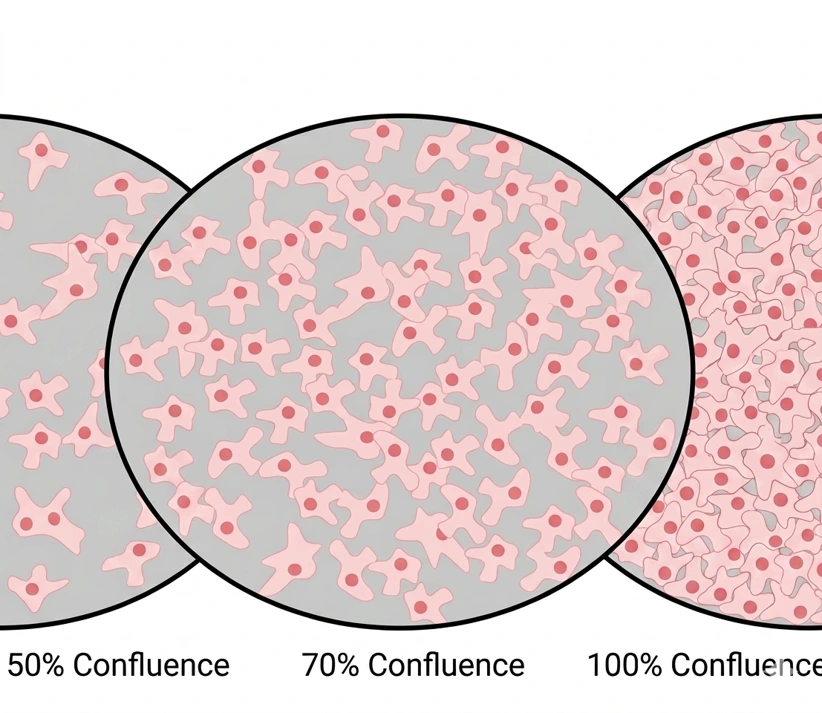
50% Confluence
"50% confluence" means that approximately half of the growth surface in a culture vessel is covered by adherent cells. It indicates that the cells may still be in the process of actively proliferating. This measurement is often used to describe the early stages of growth, where there is still space for cells to further populate the culture vessel.
70% Confluence
"70% confluence" means that approximately 70% of the growth surface in the culture vessel is covered by adherent cells. Typically, cultures at 70% have a high cell viability and proliferation rate. This state is often considered optimal for many procedures such as sub-culturing, plating, or experiments.
100% Confluence
When the entire culture surface is completely covered by cells, the cell culture is about to become over-confluent. This can trigger several issues-such as increased metabolic stress, contact inhibition, nutrient depletion, and altered cellular behavior-thereby compromising experimental outcomes and the health of the cell population. To minimize the risk of these issues, researchers try to maintain cells at an optimal confluence level, typically between 70-90% for many cell types.
Top 5 Strategies to Prevent Over Confluence
- Regular Monitoring: Regularly monitor cell cultures under a microscope to assess their confluence. This allows you to catch any signs of over confluence early.
- Optimize Seeding Density: Adjust the initial seeding density based on the growth rate of the cells. Consider reducing the seeding density, if cells tend to reach confluence quickly.
- Use Larger Culture Vessels: Increase the size of culture vessels to provide more space for cell growth.
- Adjust Media Change Frequency: Modify the frequency of media changes based on cell growth rates. An increase in media changes may slow down cell proliferation.
- Optimize Cell Culture Conditions: Ensure that cell culture conditions such as temperature, humidity, and CO2 levels are optimal for cell growth. Suboptimal conditions can lead to slower growth and reduced confluence.
Your email address will not be published. Required fields are marked *