
The Complete Guide to Oligodendrocyte Identification Markers: From OPCs to Myelinating Cells
Oligodendrocytes are the myelin-forming cells of the central nervous system (CNS), responsible for wrapping axons with multilayered myelin sheaths to ensure rapid saltatory conduction. Beyond their canonical role in myelination, oligodendrocytes and their progenitors—oligodendrocyte precursor cells (OPCs)—are now recognized as dynamic participants in metabolic support, synaptic modulation, and neuroimmune crosstalk.
Accurate identification of oligodendrocytes at distinct developmental stages is therefore fundamental to neuroscience research, drug discovery, and the study of demyelinating diseases such as multiple sclerosis. However, no single marker defines the entire lineage. Instead, researchers must rely on a combinatorial panel of transcription factors, cell-surface antigens, and structural proteins that change as cells progress from progenitor to mature myelinating oligodendrocyte.
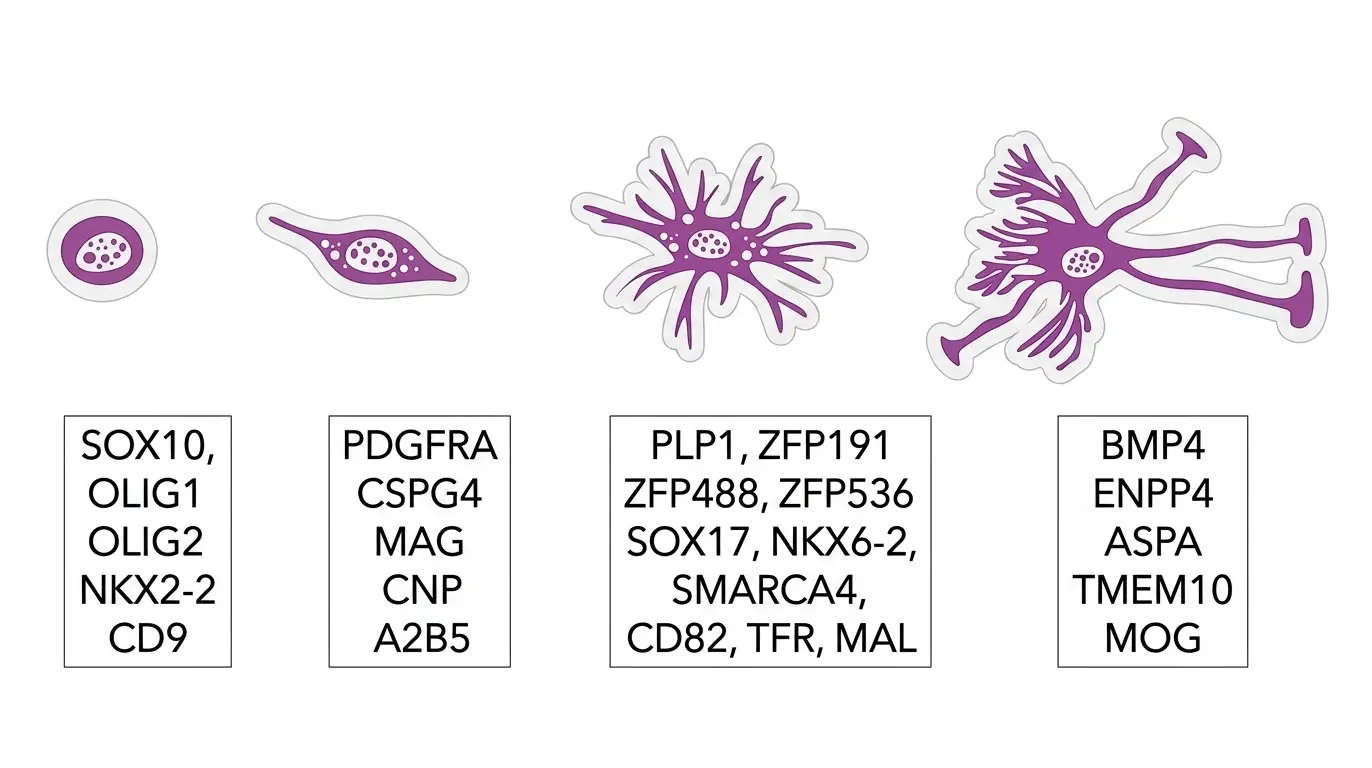
The Oligodendrocyte Lineage
Oligodendrocyte development follows a well-defined trajectory:
- OPC Specification — Neural progenitors commit to the oligodendrocyte lineage under the control of sonic hedgehog (Shh) and other morphogens.
- OPC Expansion & Migration — Proliferative, migratory OPCs colonize the developing CNS.
- Differentiation — OPCs exit the cell cycle and transition into immature, premyelinating oligodendrocytes.
- Maturation & Myelination — Cells extend processes, contact axons, and begin synthesizing myelin proteins.
Each stage is characterized by a unique molecular signature.
Pan-Lineage Markers
OLIG2
OLIG2 is a basic helix-loop-helix (bHLH) transcription factor and one of the earliest markers of oligodendrocyte lineage commitment. It is expressed in both OPCs and mature oligodendrocytes, making it an excellent pan-lineage identifier. Notably, OLIG2 is also transiently expressed in neuronal progenitors, so it should be used in combination with other lineage-restricted markers for unambiguous identification.
SOX10
SOX10 is a high-mobility group (HMG) transcription factor that is expressed throughout the oligodendrocyte lineage and is considered one of the most specific CNS lineage markers available. Its expression is induced by OLIG2 and precedes the appearance of surface markers such as NG2 and PDGFRα.
In adult tissue, all NG2+ OPCs coexpress SOX10, while many SOX10+ cells in white matter are differentiated oligodendrocytes that have downregulated NG2.
Pro Tip: OLIG2 and SOX10 can be used interchangeably as general oligodendrocyte lineage markers in long-fixed material, but antibody performance varies with fixation protocols.
OPC Markers
NG2 (CSPG4)
The chondroitin sulfate proteoglycan NG2 (encoded by CSPG4) is the canonical surface marker of OPCs. In the adult brain, essentially all nonvascular NG2-expressing cells coexpress PDGFRα and vice versa.
NG2 is rapidly downregulated upon differentiation, making it a reliable discriminator between OPCs and mature oligodendrocytes.
PDGFRα
Platelet-derived growth factor receptor alpha (PDGFRα) is the receptor for PDGF-AA, a critical mitogen for OPC proliferation and survival. Like NG2, PDGFRα is rapidly downregulated when OPCs differentiate.
A2B5
A2B5 is a ganglioside antigen widely used for the purification of rat OPCs. However, species differences are critical: mouse OPCs express A2B5 at much lower levels than rat OPCs, making NG2 or PDGFRα more suitable for mouse work. A2B5 remains valuable for isolating human OPC populations.
Immature & Premyelinating Markers
As OPCs exit the cell cycle and begin differentiating, they acquire a distinct set of markers before initiating robust myelination:
- O4 and O1: Surface antigens recognized by monoclonal antibodies. O4 appears earlier than O1 and marks the transition from OPC to immature oligodendrocyte.
- CNPase (2',3'-Cyclic-Nucleotide 3'-Phosphodiesterase): An enzyme enriched in oligodendrocyte processes; its expression precedes compact myelin formation.
- Nogo-A: A myelin-associated protein initially expressed in developing oligodendrocytes.
- ENPP6 (Ectonucleotide Pyrophosphatase/Phosphodiesterase 6): Recently identified as a marker of newly formed oligodendrocytes (NFOs).
Mature Myelinating Oligodendrocyte Markers
The terminal differentiation of oligodendrocytes is defined by the massive upregulation of structural myelin proteins:
| Full Name | Function / Notes | |
|---|---|---|
| MBP | Myelin Basic Protein | Major structural component of compact myelin; essential for sheath stability. |
| MAG | Myelin-Associated Glycoprotein | Mediates glial-axonal contact and inhibits neurite outgrowth in regeneration contexts. |
| MOG | Myelin Oligodendrocyte Glycoprotein | Located on the outermost surface of myelin sheaths; a key immunological target in demyelinating diseases. |
| GalC | Galactocerebroside | A major glycolipid of myelin; O1 antibody recognizes GalC on mature oligodendrocytes. |
| MOBP | Myelin-Associated Oligodendrocyte Basic Protein | Enriched in the major dense line of CNS myelin. |
| Opalin | TMEM10 | A novel marker of mature CNS myelin. |
These markers are typically absent in OPCs and are only robustly expressed once oligodendrocytes begin ensheathing axons.
Practical Guide to Marker Selection
Fixation Considerations
Antibody performance is highly dependent on fixation conditions. For example:
- NG2 antibodies work reliably in both short- and long-fixed tissue.
- PDGFRα antibodies often require short fixation times.
- SOX10 and OLIG2 are best detected in long-fixed material.
Recommended Co-Labeling Strategies
To unambiguously identify oligodendrocyte subpopulations, use the following combinations:
| Target Population | Recommended Panel |
|---|---|
| All oligodendrocyte lineage cells | SOX10+ / OLIG2+ |
| OPCs | NG2+ / PDGFRα+ / SOX10+ |
| Newly formed oligodendrocytes | SOX10+ / ENPP6+ / NG2− |
| Mature myelinating oligodendrocytes | MBP+ / MAG+ / SOX10+ / NG2− |
Species-Specific Notes
- Mouse OPCs: Use NG2 or PDGFRα for isolation; A2B5 is not reliable.
- Rat OPCs: A2B5 is the classical surface marker for immunopanning.
- Human OPCs: A2B5 is effective for enrichment; PDGFRα and NG2 are also applicable.
Clinical & Research Applications
Understanding oligodendrocyte marker biology has direct translational relevance:
- Multiple Sclerosis (MS): Tracking OPC markers (NG2, PDGFRα) versus mature markers (MBP, MOG) helps quantify remyelination potential in lesion tissue.
- Glioma Research: Oligodendrogliomas and certain glioblastoma subtypes retain expression of OLIG2 and SOX10, making these markers valuable for lineage-based tumor classification.
- Drug Screening: iPSC-derived oligodendrocyte differentiation protocols rely on stage-specific marker panels (OLIG2/SOX10 → O4 → MBP) to validate compound effects on myelination.
- Remyelination Therapies: Monitoring ENPP6+ newly formed oligodendrocytes provides a sensitive readout of regenerative success in preclinical models.
Accelerate Your Oligodendrocyte Research with Creative Bioarray
At Creative Bioarray, we understand that reliable cell models and validated reagents are the foundation of breakthrough neuroscience. We offer a comprehensive suite of products and services to support your oligodendrocyte and neural lineage research:
- Human Oligodendrocyte Progenitor Cells — Ready-to-use, cryopreserved primary OPCs validated for NG2, PDGFRα, OLIG2, and SOX10 expression.
- Neural Differentiation Services — Custom iPSC-to-oligodendrocyte differentiation protocols, including sequential induction of neural epithelial cells, ventralization, and OPC expansion under PDGF-AA supplementation.
- iPSC Differentiation Kits — Streamlined kits for generating neurons, astrocytes, oligodendrocytes, and microglia for high-content drug screening platforms.
- Immunofluorescence & IHC Services — Expert staining and imaging for oligodendrocyte lineage markers (SOX10, OLIG2, MBP, MOG, NG2, and more) with whole-slide imaging and quantitative analysis.
- Primary Cell Characterization — Rigorous quality control including immunofluorescence validation, flow cytometry, and mycoplasma/bacteria/fungi screening.
Whether you are modeling demyelination, screening pro-remyelination compounds, or mapping glioma lineage states, Creative Bioarray provides the cells, reagents, and technical expertise to move your research forward.
Explore our neural cell products and services →
References
- Nishiyama, A., et al. "Polydendrocytes (NG2 cells): multifunctional cells with lineage plasticity." Nature Reviews Neuroscience (2009).
- Dimou, L., & Gallo, V. "NG2-glia and their functions in the central nervous system." Glia (2015).
- Kang, S.H., et al. "Degeneration and impaired regeneration of gray matter oligodendrocytes in amyotrophic lateral sclerosis." Nature Neuroscience (2013).
- Emery, B. "Regulation of oligodendrocyte differentiation and myelination." Science (2010).
- Stolt, C.C., et al. "The Sox10 transcription factor determines glial fate choice in the developing spinal cord." Genes & Development (2003).
- Küspert, M., et al. "Olig2 regulates Sox10 expression in oligodendrocyte precursors." Journal of Neuroscience (2011).
- Birey, F., et al. "Genetic and stress-induced loss of NG2 glia triggers emergence of depressive-like behaviors through reduced secretion of FGF2." Neuron (2023).
- Marques, S., et al. "Oligodendrocyte heterogeneity in the mouse juvenile and adult central nervous system." Science (2016).
Your email address will not be published. Required fields are marked *